Use Six Sigma Thinking to Stop Repeating the Same Business Problems
Recurring problems usually point to weak process design, unclear standards or missing controls. Six Sigma thinking helps a team move from opinion to evidence and from one-time fixes to routines that last.
1. Define the Problem Clearly
A useful problem statement includes the process, defect, time period, customer impact and business impact. “Orders are wrong” is vague. “Eight orders shipped with incorrect labels in 30 days” gives the team something measurable to improve.
2. Measure Before Fixing
Measure the problem before choosing a solution. A Pareto review may show that most defects come from one product, one shift, one input field or one customer requirement. Without this step, the team may solve the loudest issue instead of the biggest one.
3. Find the Real Cause
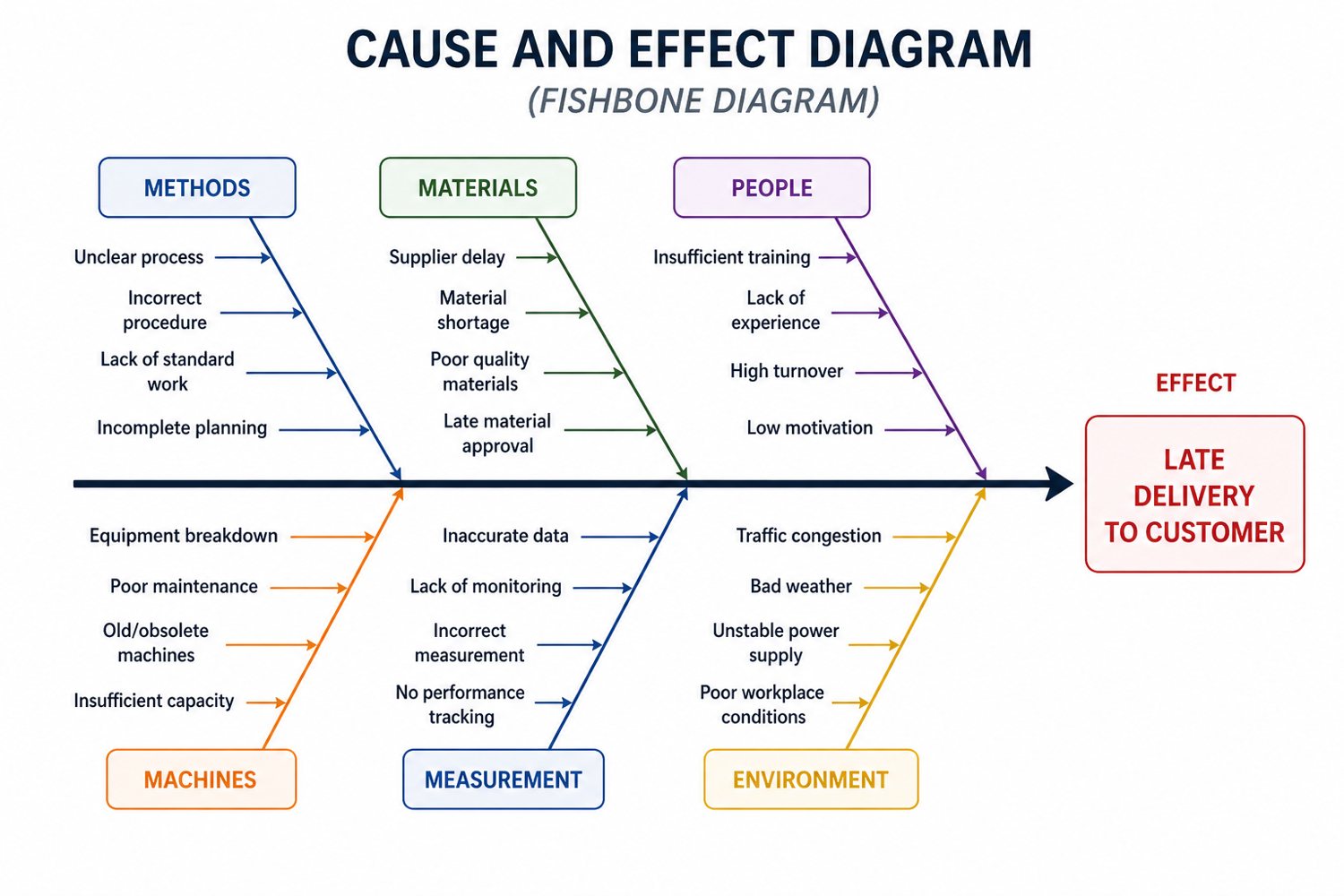
Use 5 Whys, fishbone thinking and process walks to separate symptoms from root causes. If the answer becomes “people need to pay attention,” keep going. Better questions reveal whether the standard, input, system or ownership model is failing.
A root cause should explain the observed pattern and point toward something the process can control. “Human error” rarely meets that test. Ask what information, design, condition, workload, method or feedback made the error likely.
4. Improve the Process
Effective improvements make the correct way easier to follow. This could be a required form field, a visual checklist, clearer acceptance criteria, an ERP validation rule or a standard escalation path.
Test countermeasures on a small scale. Define what you expect to change, who will observe the trial and how long the test will run. A pilot protects the operation from a large unproven change and gives the team evidence to refine the solution.
5. Control the Gain
A control plan answers what will be checked, who checks it, how often it is checked and what happens when the result is outside the standard. That is how improvement becomes part of daily work instead of another project memory.
Use the smallest useful set of measures. A team may need one outcome measure, such as defect rate, and one process measure, such as the percentage of jobs that passed a required check. Review them at the cadence where the team can still respond.
Build a problem statement that can be tested
A useful problem statement describes the gap without prescribing the fix. Include the process, the measure, the current performance, the expected performance, the time period and the business impact.
For example: “During the last eight weeks, 12% of customer orders required correction before release, compared with a target below 2%. Corrections add an average of 18 minutes per affected order and delay scheduling.” This statement gives the team a boundary and baseline. “We need a new order system” does not.
Avoid four common Six Sigma mistakes
- Starting with the preferred solution: This narrows the investigation before the cause is understood.
- Using unreliable data: Confirm definitions and collection methods before drawing conclusions.
- Analyzing without observing: Data shows the pattern; a process walk helps explain how it happens.
- Closing after implementation: The project is not complete until ownership, measures and response rules are working.
Example: recurring documentation defects
A team may initially blame training when documentation is repeatedly incomplete. Segmentation could show that most defects occur for one request type and one input channel. Observation then reveals that the required information appears in three different places and the person entering it must interpret free text.
The strongest countermeasure might combine a standard intake format, a required field and a clear exception rule. The team tracks first-pass completeness and correction time, then adds the checks to standard work. The solution improves the process instead of asking people to be more careful inside a confusing system.
For help scoping a recurring quality or workflow problem, review Lean Six Sigma consulting services.